Hare we there yet? Welcome to the era of AGI
Fighter jets, the sound barrier, and why artificial general intelligence may already be here.
My late father, an aeronautical engineer by training, used to work for Aérospatiale, a French state-owned aerospace and defense corporation that was later merged to form EADS, now rebranded Airbus SE. So growing up, I was always fascinated with aviation and military aircraft, and I sometimes draw analogies from the aerospace industry.
Today, many people think that AGI is close — Demis Hassabis of Google gives a 50% chance of achieving AGI by 2030; Dario Amodei of Anthropic sees it in 2026–2027 (see my presentation on AGI) — or that AGI is already here (see the Nature article “Does AI already have human-level intelligence? The evidence is clear”).
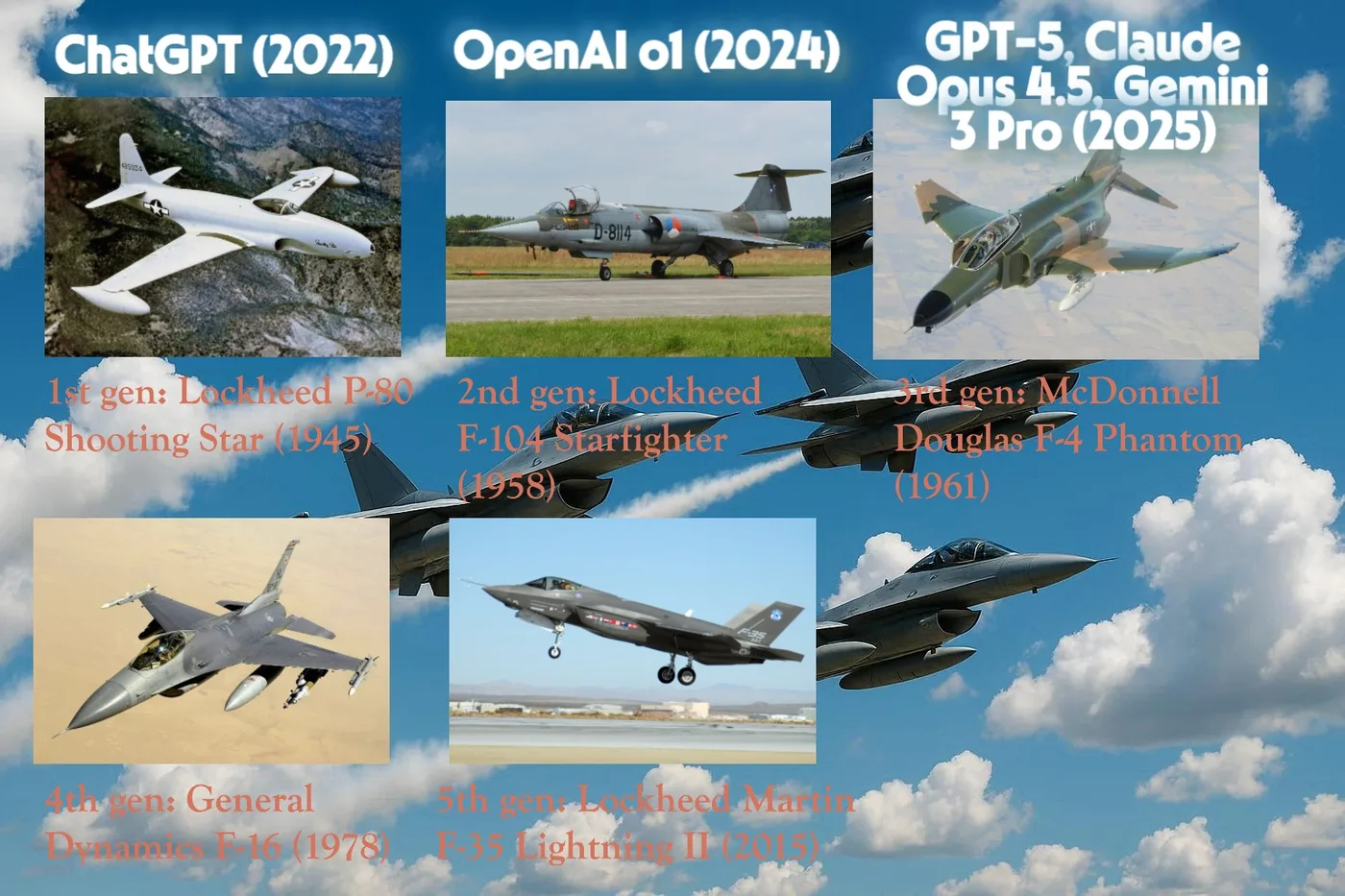
My view is that we are probably already in the era of AGI, like we have been in the era of the jet engine and fighter jets for the past eighty years since World War II. The first fighter jet was probably the German Messerschmitt Me 262 in 1942; in the US, it was the Lockheed P-80 Shooting Star in 1945.
Deep learning is like the turbojet technology that replaced piston engines and allowed supersonic flight. The first generation of fighter jets achieved subsonic speed (500 mph), and later generations went to Mach 2 and beyond (though surprisingly the F-35’s top speed is Mach 1.6, around 1,220 mph; the F-22 Raptor achieved Mach 2.2 but was discontinued). To push the analogy, human general intelligence is like the sound barrier — Mach 1. Superintelligence could be the equivalent of Mach 2.
So we had the first generation of AGI with ChatGPT in 2022, the second generation with reasoning LLMs in 2024, and the third with multimodal models that can do text, images, coding and more (GPT-5, Gemini 3 Pro, Claude Opus 4.5) in 2025. This will continue to evolve like fighter jets, now entering their sixth generation. GPT-6, Gemini 4 Pro, and Claude Opus 5 will be the next generation of AGI.
A Lockheed Martin F-35 is light-years ahead of the 1945 Lockheed P-80 in terms of capabilities, and the AGI of tomorrow will probably be light-years ahead of the 2022 version of ChatGPT — but not necessarily 100 times more intelligent. The F-35 is twice as fast, not 100 times faster, than the P-80. Maybe we will discover physical limits to intelligence based on deep learning, or we will run out of data to train the models. It is already happening with public internet data.
In the 1996 movie Twister, Dusty, played by Philip Seymour Hoffman, shouts “Jo! Bill! It’s coming! It’s headed right — for us!” Bill, played by Bill Paxton, tells him: “It’s already here.”
So welcome to the new era of AGI.
— Minh Trinh